


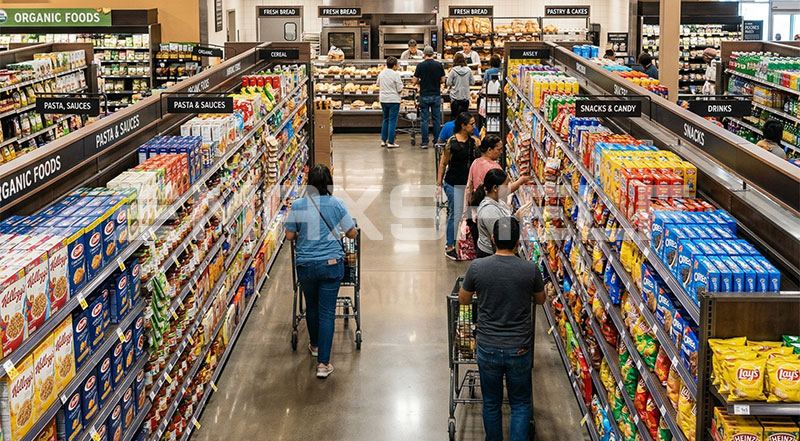
Setting up or refitting a food retail space involves dozens of decisions — and the equipment you choose shapes everything from how efficiently staff can restock shelves to how long customers spend browsing. At Maxshelf, we have been supplying shelving and display solutions to UK supermarkets, convenience stores, and food retailers since 2007. This guide covers the core equipment categories, practical layout considerations, and what to look for when specifying for different retail formats.
Whether you are planning a new store from scratch or upgrading specific sections of an existing space, the decisions covered here come up in almost every food retail project we work on.
Gondola ShelvingThe core of most food retail layouts — modular, adjustable, and designed for high-volume restocking. |
Wall ShelvingPerimeter bays that maximise vertical display capacity without consuming floor space. |
Produce DisplayTiered and angled stands for fruit, vegetables and fresh goods — built for airflow, hygiene and fast restocking. |
Food Display UnitsGlass-fronted counters, heated cabinets and refrigerated units for bakery, deli and ready-to-eat sections. |
Essential Equipment for Convenience Stores
Convenience stores present a specific challenge: high product turnover, limited floor space, and customers who expect to find what they need quickly. Getting the equipment mix right from the outset saves time on reconfiguration and avoids costly mistakes.
The most practical foundation for a convenience store is a well-planned gondola shelving system. Adjustable shelf heights allow you to reconfigure displays as your product range changes — seasonal promotions, new supplier lines, or simply moving a category that is not performing in its current position. Paired with wall shelving along the perimeter, a compact store can hold a surprisingly broad product range without feeling cluttered.
| Gondola shelving | Adjustable shelf heights allow quick reconfiguration as your range or promotions change. The foundation of most convenience store layouts. |
| Checkout counters | Compact units with integrated under-counter storage keep the till area functional without consuming valuable floor space. |
| Refrigerated units | Essential for chilled and frozen goods — both for food safety compliance and for meeting customer expectation in any food retail environment. |
| End-cap displays | Gondola end positions consistently outperform mid-aisle for impulse lines. Rotating promotional products through these positions every few weeks keeps the store feeling fresh and drives repeat visits. |
Supermarket Shelving and Display SolutionsLarger supermarket formats require shelving that can handle constant restocking, heavier product loads, and the wear that comes with high footfall. Standard gondola units work well for the majority of the shop floor, but the specification — frame gauge, shelf depth, load rating — matters more at scale. For supermarkets, the layout usually divides into distinct zones: ambient grocery, chilled, fresh produce, bakery, and household. Each zone benefits from shelving configured specifically for it rather than a one-size-fits-all approach. Maxshelf gondola systems are modular, meaning you can start with a base configuration and expand bay by bay as your range or footprint grows — without having to replace existing units. |
|
How to Optimise Space in Small Supermarkets
Small-format supermarkets — increasingly common as operators expand into urban and suburban locations — need to work harder for every square metre. A few layout principles consistently make a measurable difference.
Installing taller gondola units is the most straightforward way to increase display capacity without expanding the footprint. Moving from a standard 1.6m unit to a 1.8m or 2.0m unit adds a full shelf level without touching your aisle plan.
Slimline shelving in narrower aisles keeps traffic flowing while maintaining product density. Eye-level placement of high-margin products is well-established retail practice, but worth revisiting periodically — customer eye level for adults typically falls between 1.2m and 1.6m from the floor, and products placed in this range consistently see higher pick rates than those shelved below knee height or above shoulder height.
Finally, checkout zones are frequently underused for storage. Integrating under-counter storage into your till area can free up significant back-of-house space in a compact store.
Layout Insight: Aisle width only needs to meet minimum requirements — every additional centimetre beyond that is better spent on display depth. In a small supermarket, the difference between a 1.6m and 2.0m gondola unit can add the equivalent of an entire extra aisle of product capacity.
Fruit and Veg Display EquipmentFresh produce is often the first category customers encounter — and their impression of it sets the tone for the rest of the shop. Presentation matters as much as freshness. Tiered and angled displays are the standard for good reason: they improve visibility across the full range, reduce handling damage compared with flat tables, and make restocking faster because staff can top-fill from the back. Wooden produce tables and crates work well for farm shops and independent retailers looking for a warmer, artisan aesthetic. Metal frame units are better suited to supermarket environments where hygiene, durability and restocking speed take priority. |
|
Bakery and Food Display Solutions
Bakery sections — whether an in-store bakery or a range of packaged goods — require a different approach to shelving and display than ambient grocery.
| Glass-fronted counters | Protect products while keeping them fully visible. Standard for in-store and artisan bakery sections. |
| Heated display cabinets | Hot-hold units must comply with food safety temperature requirements — specifying the right cabinet for the product type is not optional. |
| Refrigerated deli units | For pre-packed sandwiches, quiches and ready meals — maintains temperature compliance while keeping products fully visible to customers. |
| Display lighting | Warm-tone LEDs flatter baked goods; cooler tones work better for fresh produce and chilled goods. Lighting within display cases has a material effect on how products look. |
Equipment Considerations by Store Format
Convenience StoresCompact gondola runs with adjustable shelving, refrigerated units for chilled goods, and end-cap displays for impulse lines. Wall bays along the perimeter add significant capacity without reducing aisle space. |
Small SupermarketsTaller gondola units to maximise vertical capacity, category-specific shelving configurations for produce and bakery, and promotional islands near the entrance for high-margin or seasonal lines. |
Farm Shops & IndependentsWooden produce tables and crates for a warm, artisan aesthetic. Flexible display formats that can accommodate a changing seasonal range without costly reconfigurations. |
Larger SupermarketsHeavy-duty gondola systems rated for constant restocking and high product loads. Modular layouts that allow zone-by-zone expansion as the range grows, without replacing existing equipment. |
Why Equipment Quality Affects More Than Just Durability
Retailers sometimes frame the equipment decision primarily around upfront cost. In practice, the more significant costs are operational — shelving that warps or corrodes under load means unplanned replacement; units that cannot be reconfigured mean a full refit when the range changes; display fixtures that look tired within two years undermine the store environment regardless of product quality.
Maxshelf stocks over £3 million worth of retail shelving and display equipment from our warehouse in Elstree, Borehamwood — which means shorter lead times and the ability to phase deliveries around your build or refit schedule. We have been working with UK food retailers, supermarket operators, and convenience store owners since 2007, and our team is available six days a week if you need specification advice before committing to an order.
Frequently Asked Questions
|
What is the standard gondola shelving height for a convenience store? The most common heights are 1.6m and 1.8m. Stores where visibility across the shop floor matters — such as small convenience stores where one staff member may be managing the till and the floor simultaneously — often prefer 1.6m units. Larger formats and supermarkets typically use 1.8m or 2.0m to maximise display capacity. |
|
How much weight can retail gondola shelving hold? This depends on the specification. Standard commercial gondola shelves typically carry 50–80kg per shelf. Heavy-duty variants rated for 100kg+ are available for bulk goods, beverages and canned products. Always confirm load ratings before specifying for heavy product categories. |
|
Can gondola shelving be reconfigured after installation? Yes — this is one of the primary advantages of modular gondola systems. Shelf heights are adjustable within the upright track without tools in most cases. Bay extensions and end-cap additions can also be integrated into an existing run without replacing the whole unit. |
|
Do you supply equipment for both new stores and refits? Yes. We work with both new-build retail projects and existing stores that are upgrading sections or reconfiguring their layout. Our team can advise on phased delivery if the refit needs to happen around trading hours. |
Planning a New Store or Refit?
Browse our full range of shelving and display equipment — or visit our Elstree showroom to see the systems in person before you order.